

New Speakers, New Identities: Ideologies of Conversion in Wartime Ukraine

Date and Time
Location
A lecture by Natalia Kudriavtseva, HURI Research Fellow and Professor of Linguistics and Translation Studies at Kryvyi Rih State Pedagogical University, Ukraine
Moderated by Laada Bilaniuk, HURI Research Fellow
Attendees are invited to enjoy an informal lunch.
About the Lecture
The lecture examines ideologies behind linguistic conversion—a transition to Ukrainian while abandoning Russian—which intensified in Ukraine after the onset of Russian aggression in 2014, and particularly after the 2022 Russian full-scale invasion. Employing ‘new speakerness’ as a theoretical lens, the study draws on biographical interviews with twenty-one individuals who became full-time Ukrainian speakers and were recruited from informal language-learning initiatives across Ukraine. The analysis focuses on how the new speakers legitimize their ownership of the Ukrainian language and construct identities aligned with their linguistic transition. Particular attention is paid to the normative expectation of speaking “pure” Ukrainian, traditionally regarded as the most authentic expression of Ukrainian identity.
The findings suggest that, while the ideal of purity remains symbolically powerful, it is frequently questioned in practice. New speakers tend to prioritize fluency, communicative efficacy, and social participation over strict adherence to prescriptive norms. Hybrid and translingual practices—including Surzhyk—are often reframed not as deficiencies but as legitimate forms of linguistic expression indexing a unique ‘local’ Ukrainian identity. Linguistic conversion thus emerges as both a political act and a site of ideological transformation.
About the Speaker
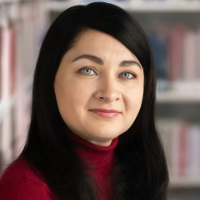
Dr. Natalia Kudriavtseva is Professor of Linguistics and Translation Studies at Kryvyi Rih State Pedagogical University, Ukraine. Her academic career began with a focus on social and political theory and led to a PhD in Social Theory from the National Academy of Sciences of Ukraine (Kyiv). She subsequently continued her training at the Institute of Linguistics of the National Academy of Sciences, earning a habilitation degree in General Linguistics and Theory of Translation from Taras Shevchenko National University of Kyiv.
Prof. Kudriavtseva specializes in critical sociolinguistics, (socio)linguistic ethnography, and the sociology and ethnography of translation. Her research is organized around three interrelated strands: language ideology, language and power, and translation as social practice. Her recent publications include the volume Language and Power in Ukraine and Kazakhstan: Essays on Education, Ideology, Literature, Practice, and the Media (Stuttgart: Ibidem, 2024), co-edited with Debra A. Friedman. She has also published numerous articles in Language in Society, Journal of Multilingual and Multicultural Development, Heritage Language Journal, Ideology and Politics Journal, as well as policy papers for Kennan Focus Ukraine, Forum for Ukrainian Studies, and Ukrainian Analytical Digest.
In addition to her teaching position, Natalia Kudriavtseva has held research fellowships at the Woodrow Wilson International Center for Scholars (USA), the University of Cambridge (UK), the Alfried Krupp Institute for Advanced Study Greifswald and the Hanse Institute for Advanced Study (Germany), the Centre for Advanced Study Sofia (Bulgaria), and the School for Advanced Study in the Social Sciences (EHESS), Paris (France).
This event is organized by HURI as part of the Ukraine Study Group public event series.
Persons with disabilities who wish to request accommodations or who have questions about access should contact HURI (huri@fas.harvard.edu) at least two weeks in advance of the session.
Watch videos of past HURI events on our YouTube channel and subscribe to our email list to receive announcements about events and other activities.