

Natalia Kudriavtseva
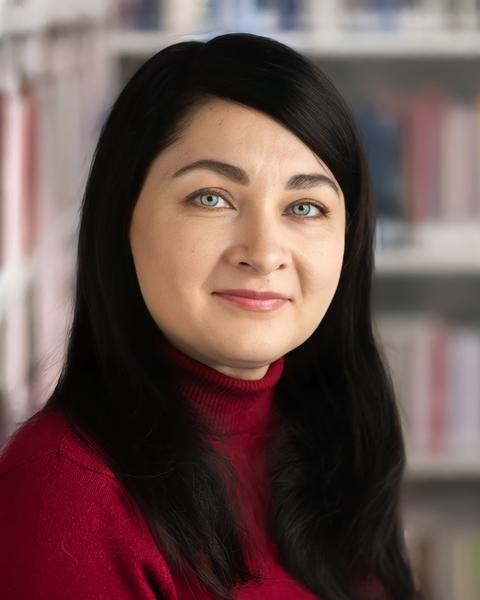
Research Fellow at the Harvard Ukrainian Research Institute
February - May 2026
Supported by HURI with the Alex Woskob Family Foundation Endowment Fund
Research Project
‘If They Are Ukrainians by Spirit…’: Ideologies of Language and Identity in Wartime Ukraine
Wartime Ukraine has been marked by profound sociolinguistic developments, most notably an intensified shift to Ukrainian from Russian. This transition occurs either as a radical linguistic conversion involving the abandonment of Russian or through an expanded use of Ukrainian as an additional language. In both forms, the linguistic transition functions as a key site for the construction of new social and political identities. As linguistic practices change, language ideologies – beliefs, feelings, and affective orientations toward language and communication – become especially salient.
This project pursues two interrelated objectives. First, it examines Russian-speaking Ukrainians who have transitioned to, or are in the process of acquiring, Ukrainian. Adopting an ethnographic perspective, the study draws on biographical interviews with sixty-five individuals identified as new speakers of Ukrainian residing in northeastern and southeastern Ukraine. The analysis explores shifting perceptions of Ukrainian and Russian, the identities associated with these languages, and the evolving evaluation of the mixed Ukrainian–Russian variety Surzhyk.
Second, the project investigates how the notion of identity transformation through linguistic transition circulates transnationally and is articulated across languages via translation. At the intersection of ethnographic and sociological perspectives, it analyzes Olena Stiazhkina’s Cecil the Lion Had to Die – both the original (Vydavnytstvo Staroho Leva, 2021) and the English translation (HURI Books, 2024) – a novel that begins in Russian and ends in Ukrainian, mirroring the author’s own transition as a civic and political stance. Drawing on interviews with Stiazhkina and her English translators, the project provides further insight into the entanglement of language, identity, and war in Ukraine.
Biography
Natalia Kudriavtseva is Professor of Linguistics and Translation Studies at Kryvyi Rih State Pedagogical University, Ukraine. Her academic career began with a focus on social and political theory and led to a PhD in Social Theory from the National Academy of Sciences of Ukraine (Kyiv). She subsequently continued her training at the Institute of Linguistics of the National Academy of Sciences, earning a habilitation degree in General Linguistics and Theory of Translation from Taras Shevchenko National University of Kyiv.
Prof. Kudriavtseva specializes in critical sociolinguistics, (socio)linguistic ethnography, and the sociology and ethnography of translation. Her research is organized around three interrelated strands: language ideology, language and power, and translation as social practice. Her recent publications include the volume Language and Power in Ukraine and Kazakhstan: Essays on Education, Ideology, Literature, Practice, and the Media (Stuttgart: Ibidem, 2024), co-edited with Debra A. Friedman. She has also published numerous articles in Language in Society, Journal of Multilingual and Multicultural Development, Heritage Language Journal, Ideology and Politics Journal, as well as policy papers for Kennan Focus Ukraine, Forum for Ukrainian Studies, and Ukrainian Analytical Digest.
In addition to her teaching position, Natalia Kudriavtseva has held research fellowships at the Woodrow Wilson International Center for Scholars (USA), the University of Cambridge (UK), the Alfried Krupp Institute for Advanced Study Greifswald and the Hanse Institute for Advanced Study (Germany), the Centre for Advanced Study Sofia (Bulgaria), and the School for Advanced Study in the Social Sciences (EHESS), Paris (France).