

Voices of Ukraine: Storytelling in Rebuilding Ukraine and the World
by Sofiia Tiapkina
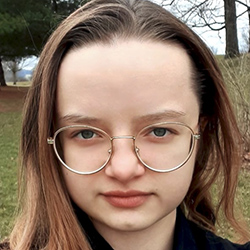
| Born and raised in Ukraine, Sofiia Tiapkina is a junior at Northfield Mount Hermon School in Gill, MA. She is a finalist and volunteer of Ukraine Global Scholars, a non-profit organization that helps Ukrainian youth from modest backgrounds achieve education in top-world institutions. Sofiia is a passionate writer and visual artist whose work was published in the Voices of Ukraine: Impressions Around War anthology. |
***
This blog post focuses on the role of storytelling in rebuilding Ukraine and the world, taking inspiration from the 2023 TCUP conference on 9-10 February 2023. I will summarize the key points of the second panel discussion, "Truth and Justice", and use Oleksandra Matviichuk’s Keynote Address as a framework for describing how active and deliberate storytelling has the potential to establish peace, justice, and the future of Ukraine and the world.
Establishing Truth and Justice for Ukraine
Moderated by Natalia Khanenko-Friesen, the "Truth and Justice" panel started by addressing transitional justice and its gradual implementation in Ukraine. Transitional justice is how societies respond to massive and severe human rights violations. It encompasses numerous grievances that the trauma creates in communities and nations, striving to institute truth and memory, reparations, warranties, and societal engagement, among many others. It asks difficult questions about whether, how, and what to rebuild in the recovering society. Above all, transitional justice focuses on victims. Each victim holds a unique story, and the answers to these questions could never be the same, just like transitional justice processes could not be fully replicated from one context to another.

Ukraine’s historical and cultural context became a point of discussion among the panelists. Anton Korynevych, ambassador-at-large at the Ministry of Foreign Affairs of Ukraine, brought up Zelensky’s ten-point peace formula, addressing the issue of accountability. Two subjects, he stressed, dealt with the crux of the matter of justice in Ukraine. First, accountability must be established for Russia’s chief crime – the crime of aggression that led to thousands of war crimes. Then, to rectify the atrocities, a compensation mechanism must register and provide for the needs of the victims. Besides these judicial mechanisms, the panel brought up the non-judicial ones. Hasan Hasanović, a Srebrenica genocide survivor and a curator and interpreter at the Srebrenica-Potočari Memorial Center, shared his experience. He drew similarities between the wars in Bosnia and Ukraine, pointing to the international community’s lack of response to the initial calls for aid that allowed the brutal war crimes to happen. Hasanović identified the non-judicial mechanisms that helped Bosnians preserve the truth of the war crimes. As Serbs targeted men and boys, it was the efforts of women that became crucial in documenting the story of the Srebrenica genocide. The historical revisionism movement they started inspired social change in Bosnian reconstruction after the war.
Ukrainian writer and activist Victoria Amelina echoed the non-judicial means for bringing justice. In her words, “Right now, we are in the place where we have all the pieces of the puzzle; we just need to put them all together.” Amelina urged Ukrainians and the world to understand the grand narrative of the Ukrainian nation. For decades, people have misunderstood the relationship between Ukraine and Russia. Ukrainians held historical distrust of their government, launching revolutions against post-USSR and pro-Russian regimes. The international society viewed Ukraine, if not as part of Russia, then as a near-identical “smaller brother.” Now is a chance for Ukrainian civil society to collaborate with its government. Now is the time for the world to see Ukraine for what it is – a unique and independent nation. Justice will come as Ukrainians, and the global community, bring about the transition from the colonial past to the sovereign future of Ukraine.
Maria Tomak, Head of the Crimea Platform Department at the Mission of the President of Ukraine, also emphasized the urgency of truth-seeking to prevent future invasions. Through her work with Crimea, Tomak came to know the various layers of misinformation and occupation of the region. Since the annexation in 2014, Russia has enforced propaganda, destructive educational reforms, and militarization of children, among other hostilities. Further, Crimea has been excluded from the policies about decommunization and preserving collective Ukrainian memory. Tomak explained that Russian imperial and USSR narratives, as well as the colonial past, are particularly prevalent in her work. She called for a cognitive de-occupation of Ukraine.
The Impact of Storytelling on Ukraine and the World
Keynote speaker Oleksandra Matviichuk gave an address that encapsulated the message of Rebuilding Ukraine, Rebuilding the World. She focused on the ways in which individual stories can address issues of peace, recovery, and the future of Ukraine.

“Peace is the freedom to live without fear,” Matviichuk said, opening her speech. Yet, the people in occupied territories experience Russian terrors in the cruelest ways. Volodymyr Vakulenko was a Ukrainian children’s writer and poet. Killed and buried in the Izium mass grave, Volodymyr was one of the many Ukrainians whose lives were taken for their loyalty to Ukraine. Despite her extensive work documenting war crimes since 2014, Matviichuk declared that she was “unprepared for the atrocity” that the Russian invasion brought to Ukraine. Volodymyr’s story, along with thousands of others, is a testament to the international community’s reluctance to provide arms and aid to support Ukraine. Seeing personal tragedies among the magnitude of the Russian aggression is what helps us maintain our humanity during the war. Matviichuk explained that the individual victim stories exemplify the fear that Ukrainians face every day and the urgency of bringing peace.
Russia’s war is genocidal in its nature, she continued, and justice is vital in a full restoration of peace in Ukraine. Matviichuk shared the story of a Serbian soldier who committed war crimes in the Srebrenica genocide. After thirty-one years of inaction, journalists started investigating him. Equipped with open sources and new technology, they identified the man and learned he never faced any charges. Now, we also have “all the pieces of the puzzles” that Victoria Amelina described in the Truth and Justice panel. Resources to inspect metadata and identify geolocations and similar photos enable common people to become a part of the justice mechanism. Documenting the war crimes, Matviichuk said, is a necessary step in enforcing the law in times of terror. “Justice should be independent of the strength of an authoritarian regime,” and so recording the war stories brings the war closer to its just end.
Concluding her speech, Matviichuk admitted that “predicting the future is an ungrateful task.” The influencing factors are so numerous that any prediction may become outdated in a matter of weeks. Still, the past provides us with powerful information that makes the future less uncertain. Matviichuk shared the story of Roman Huryk, a 19-year-old activist killed during the Revolution of Dignity in 2014. His mother begged him not to go, yet ten years prior she herself stood with other protesters on the streets of Kyiv, united by the Orange Revolution. Past behavior is the best predictor of the future. If we can’t rely on legal instruments, Matviichuk repeated, we can still rely on ordinary people. In times of adversity, “ordinary people do extraordinary things” and reveal the best of humanity: staying courageous, fighting for freedom, taking responsibility, and helping each other. This is the hard but hopeful future Matviichuk envisions for Ukraine.

Throughout the entire conference, one conclusion was clear – that rebuilding Ukraine means rebuilding the world. The keynote address and different panels pointed to the interdependence of the internal and external, national and international. The stories of fighting for peace, justice, and a future are not constricted by national borders; they are universal. Telling these stories empowers not just Ukrainians but the whole world to stand up for what is right. As Oleksandra Matviichuk finished her address, “in our interconnected world, only the expansion and spread of freedom makes our world safer.”