

Ukraine Endures: Russia's War Against Ukraine in Pictures
| ||||
Maksym Levin • Evgeny Maloletka • Oksana Parafeniuk • Pierre Toutain-Dorbec | ||||
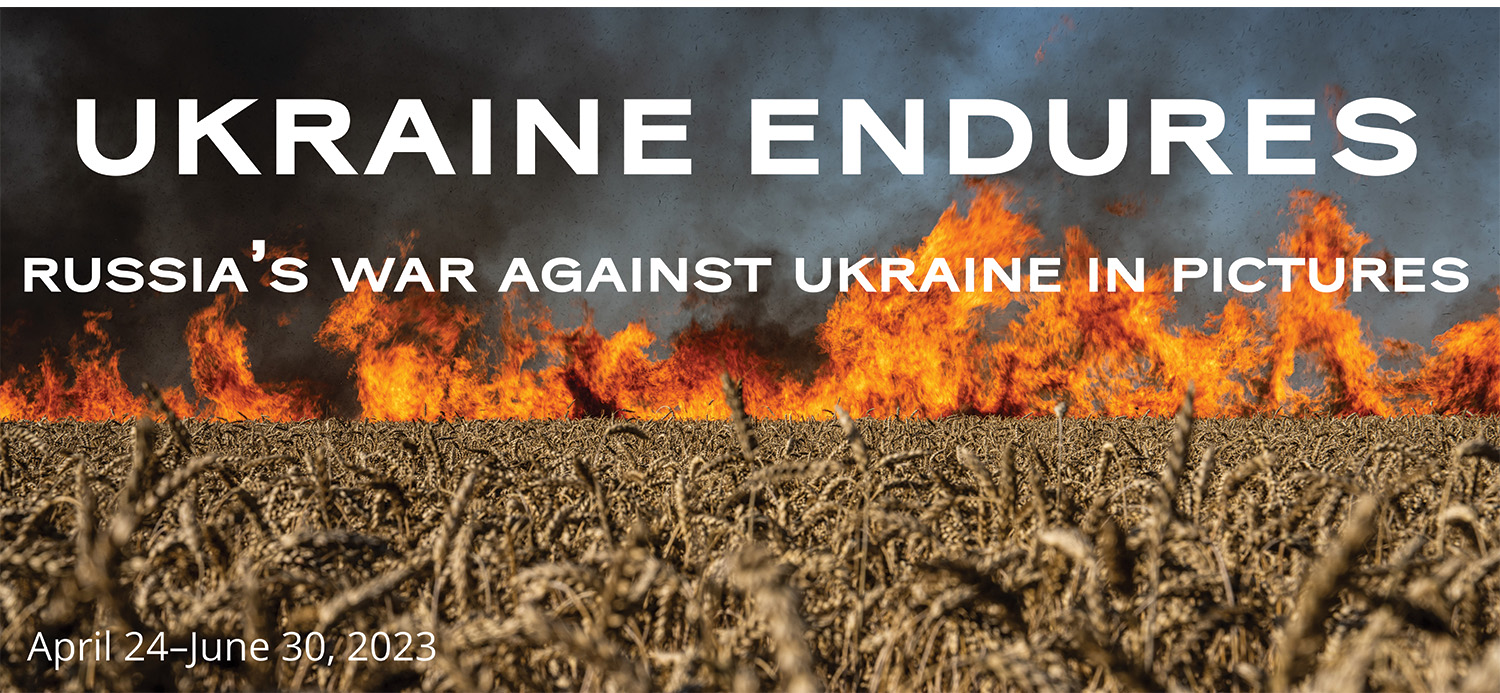
On February 24, 2022, Russia launched a full-scale invasion of Ukraine, turning an eight-year bloody conflict into a war of catastrophic proportions. Seemingly against all odds, Ukraine has withstood an existential threat from a larger, better-armed foe, but not without great cost. Cities like Bucha, Mariupol, and Bakhmut have come to symbolize Russia’s brutal war of attrition, as centers of life are reduced to rubble and mass graves. Photographs from the war zone not only document mass atrocities and inform the world; they also tell stories of resilience and inspire humanitarian action. With this exhibit, we remember and mourn those who have been lost while commending the courage of those who fight for freedom, justice, and peace. Content Warning: Many of the photographs included in this exhibit depict graphic injury and death. Organized by the Harvard Humanitarian Initiative and the Ukrainian Research Institute, Harvard University, with generous support from the Davis Center for Russian and Eurasian Studies, the Nieman Foundation for Journalism, the Shevchenko Scientific Society in the USA, and Razom for Ukraine. Fisher Family Commons, CGIS Knafel Building, 1737 Cambridge Street, Cambridge, MA |
How You Can Help Ukraine
Continuing to support Ukraine is critical both now and in the future as Ukraine rebuilds after the war. We encourage supporting organizations with minimal overhead costs, efficient operations, transparency in spending, and local expertise. There are many such organizations; here are a few that we recommend:
Come Back AliveSupports the Armed Forces of Ukraine by financing new technologies, training, and ammunition to save the lives of Ukrainians and help soldiers protect Ukraine. | Razom for UkraineProvides critical humanitarian war relief and recovery to address the most urgent needs as they evolve. Places all aid directly into the hands of the people in Ukraine. | Center for Civil LibertiesAdvocates for human rights, democracy, and solidarity in Ukraine and the OSCE region. Investigates war crimes in Ukraine. Won the Nobel Peace Prize in 2022 along with two other organizations. |
HospitalliersVolunteer organization of paramedics who deliver life-saving support to all in need on the frontlines. Donations provide the necessary equipment for emergency care and evacuating the wounded. | forPeaceSupports existing Ukrainian supply chains and provides the essential link between foreign aid and the speed and nuanced insight of on-the-ground all-Ukrainian networks. | World Central KitchenProvides meals in response to humanitarian, climate, and community crises. They build resilient food systems with locally led solutions. |
Sunflower of PeaceProvides life-saving medical and humanitarian aid to Ukrainians most gravely affected by the war. | Helping to Leave24/7 evacuation helpline. After verifying information, including potential drivers, they arrange for safe evacuation out of Ukraine. | Superhumans CenterRuns a state-of-the-art rehabilitation center to give adults and children affected by the war a chance for a decent life, including prosthetics for those injured by the violence. |
Serhiy Prytula Charity FoundationFocused on strengthening the Defense Forces of Ukraine and providing assistance to the civilians affected by Russian aggression. | Save UkraineThe only public organization in Ukraine that regularly organizes and successfully conducts Rescue Missions to return Ukrainian children who had been deported to Russia. | Shevchenko Emergency FundSupports scholars, writers, and artists who have been affected by Russia’s war against Ukraine through residential and non-residential fellowships. |
For more ways to help, whether financially or through volunteer work, see our Russia’s War on Ukraine resource page.
More Information About Russia's War Against Ukraine
On February 24, 2022, the world watched in horror as Russia launched a full-scale invasion of Ukraine, inciting the largest war in Europe since World War II. In the months prior, Western intelligence had warned that the attack was imminent, amidst a concerning build-up of military force on Ukraine’s borders. The intelligence was correct: Putin initiated a so-called “special military operation” under the pretense of securing Ukraine’s eastern territories and “liberating” Ukraine from allegedly “Nazi” leadership (the Jewish identity of Ukraine’s president notwithstanding).
Once the invasion started, Western analysts predicted Kyiv would fall in three days. This intelligence could not have been more wrong. Kyiv not only lasted those three days, but it also eventually gained an upper hand, liberating territories Russia had conquered and handing Russia humiliating defeats on the battlefield. Ukraine has endured unthinkable atrocities: mass civilian deaths, infrastructure destruction, torture, kidnapping of children, and relentless shelling of residential areas. But Ukraine persists.
With support from European and US allies, Ukrainians mobilized, self-organized, and responded with bravery and agility that evoked an almost unified global response to rally to their cause and admire their tenacity. Despite the David-vs-Goliath dynamic of this war, Ukraine had gained significant experience since fighting broke out in its eastern territories following the Euromaidan Revolution in 2014. In that year, Russian-backed separatists fought for control over the Donetsk and Luhansk regions in the Donbas, the area of Ukraine that Russia later claimed was its priority when its attack on Kyiv failed. Also in 2014, Russia illegally annexed Crimea, the historical homeland of indigenous populations that became part of Ukraine in 1954. Ukraine was unprepared to resist, and international condemnation did little to affect Russia’s actions.
In the eight years between 2014 and 2022, Ukraine sustained heavy losses in the fight over eastern Ukraine: there were over 14,000 conflict-related casualties and the fighting displaced 1.5 million people. Russia encountered a very different Ukraine in 2022, one that had developed its military capabilities and fine-tuned its extensive and powerful civil society networks after nearly a decade of conflict. Thus, Ukraine, although still dwarfed in comparison with Russia’s GDP ($536 billion vs. $4.08 trillion), population (43 million vs. 142 million), and military might (500,000 vs. 1,330,900 personnel; 312 vs. 4,182 aircraft; 1,890 vs. 12,566 tanks; 0 vs. 5,977 nuclear warheads), was ready to fight for its freedom and its homeland. Russia managed to control up to 22% of Ukraine’s territory at the peak of its invasion in March 2022 and still holds 17% (up from the 7% controlled by Russia and Russian-backed separatists before the full-scale invasion), but Kyiv still stands and Ukraine as a whole has never been more unified.
Statistics in a time of war are difficult to obtain. In areas of mass atrocities, such as Bucha and Mariupol, Russia has tried to cover up some of the civilian deaths through incineration and mass graves. Reports of military losses take on political and strategic meaning as they can affect morale and public support. As fighting continues, numbers constantly change. That said, reputable sources have published estimates to give us a sense of the scale of this war. According to reports accessed on April 15, 2023:
8,490 civilians have been killed in Ukraine, including 500 children. Another 943 children have been injured in the war. Source: OCHA HDX Ukraine data explorer and CNBC
Some 6,000 Ukrainian children are in Russian custody; the Ukrainian government estimates over 16,000 children have been taken to Russia. Many lose contact with their families and are put up for adoption with Russian families. Forcibly deporting children is a war crime. Source: Yale School of Public Health and BBC
Ukrainian authorities have registered over 90,000 atrocity crimes. Source: Eli Rosenbaum at Harvard
8.2 million refugees fled Ukraine and sought shelter across Europe; 5.4 million people are internally displaced. Source: OCHA/ HDX Ukraine Data Explorer
15 journalists, photojournalists, and other members of the press have been killed in the full-scale war; 10 were killed between 2014 and 2022. These deaths are attributed to dangerous assignments, crossfire, or murder. Maksym Levin, one of the photographers of this exhibit, was among those killed. Reports indicate he was unarmed and executed by Russian soldiers. Source: Committee to Protect Journalists
As of February 2023, Western reports indicate 100,000 Ukrainian troops have been wounded or killed; Ukraine stated in August that over 9,000 of its troops died. Western experts put Russia’s military losses at 200,000; Russia counted 6,000 military deaths in September. Source: AP News
Find more resources on Ukraine and the war on our website, especially our Russia's War on Ukraine resource page.