

TCUP 2024: Panel 2
The second panel of the 2024 TCUP conference dwelt on Ukraine’s regional identity. This discussion was moderated by Timothy Colton, a professor of government and Russian studies at Harvard. As he opened the talk, Colton questioned which geographic zone Ukraine should identify with: ““Is it part of Europe? Is it part of Eastern Europe, Central Europe, Eurasia? None of the above, several of the above, all of the above?” The challenge of the debate was to find a framework that fit Ukraine’s modern reality, and rejected the shadow of Russian colonial influence.
Eugene Finkel from Johns Hopkins University started the talk by putting out the view that Ukraine’s national character is too liberal and democratic to fit into Eastern European or Central European regional definitions, as evidenced by the current position of countries such as Hungary. He speculated that the country could be categorized as “post-Soviet,” even as he added that Ukraine rejects its Soviet legacy, while neighbors (such as Belarus) attempt to become “neo-Soviet.” In the end, he rejected the notion of considering Ukraine a part of the region of “Eurasia.”
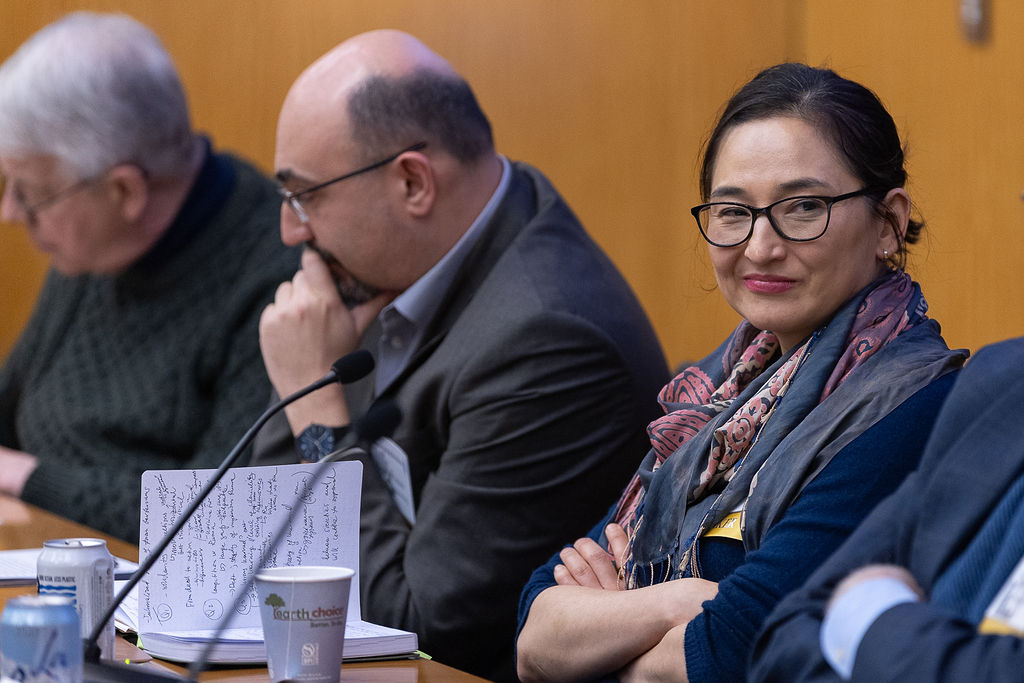
National Defense University professor Erica Marat acknowledged the complexity of Ukraine’s identity. She compared the ambiguity of Ukraine’s identity to Central Asia, the area she herself hails from and where she has done extensive research. This region shares cultural crossover with both Western China and Afghanistan. Marat also compared Central Asia’s recent political experiences to the Caucuses, North Asia, and Ukraine. Surrounded by looming influences, Marat suggested that creativity is required for such regions to construct a novel view of the self. She spoke about “post-colonial solidarity,” wherein countries including Ukraine go through similar, though not identical, decolonizing experiences. By dismantling old systems, these regions undergo a “liberation of the mind” which ultimately translates to “governance structures that will be more inclusive of a postcolonial world,” in Marat’s words.
Stanford University-based historian Norman Naimark held the view that Ukraine may be geographically in Eurasia, but should be culturally viewed as European. He noted that Ukraine, much like the Balkans, has been placed as a crossroads of civilizations, subjected to repeated invasions and occupations. Still, Naimark professed a belief in self-identification: Ukraine wants to be European, “So why say they're not a part of Europe?” He claimed that Ukrainians don’t simply want to belong to the European Union, or NATO, but rather, “Europe as such, meaning a democratic rule of society.” He echoed the sentiments of a prior panelist, that such an inclusion would serve as an impetus for the rest of Europe to “be more European.”
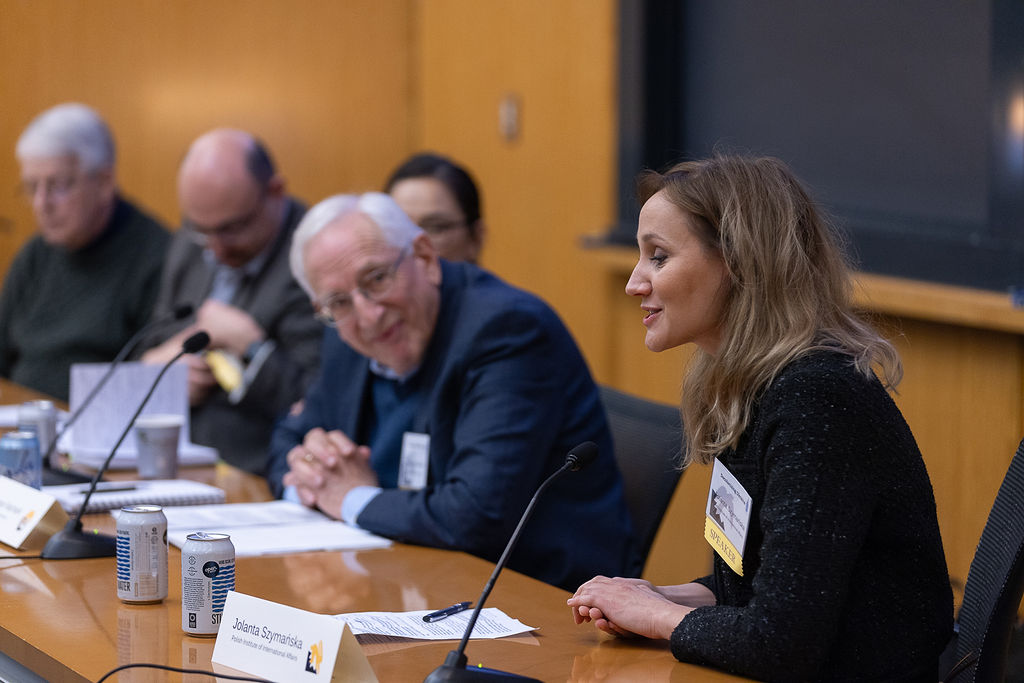
Jolanta Syzmanska from Polish Institute of International Affairs indicated that creating broad regional categorizations was an unhelpful approach to Ukraine. She said that the EU had made policy errors toward its eastern neighbors, by roughly grouping post-Soviet countries, such as Belarus, Ukraine, and Azerbaijan, in the same box. Noting that all three of these nations have wholly different circumstances, she encouraged the attendees to remember the uniqueness of Ukraine and its historical ties to central and eastern Europe. In other words, we should focus on Ukraine’s distinctiveness for a deeper understanding of its claims for EU membership, rather than slapping on easy labels like regional categories.
Finkel and Marat agreed that interest in studying Russia will inevitably persist. However, they beseeched the attendees to alter the angle from which we study Russia, to inspect the deeper issues within the country. Noting that the study of Eastern Europe has been traditionally dominated by Russian scholars, they acknowledged that research has become more inclusive towards other regional voices, and they voiced hope that this will lead to greater decolonization of area studies.