

TCUP 2024: Panel 1
The first panel of the 2024 TCUP conference covered the foundations of decolonization. This meant delving into original dialogues about the implications of decolonization, when it comes to policies and practices. The panel began with an acknowledgement of the lives lost in the Russo-Ukrainian war, including Victoria Amelina, a HURI colleague, previous conference speaker and recognized Ukrainian novelist who was killed in a missile strike.
The first speaker, Tarak Barkawi of John Hopkins University, critiqued Eurocentric world perspectives, which exclude the experiences of colonies and the global south. Barkawi endorsed a restoration of indigenous frameworks. He rejected the internalized idea that nations such as Ukraine are uncultivated and need the guidance of colonial forces to elevate them.
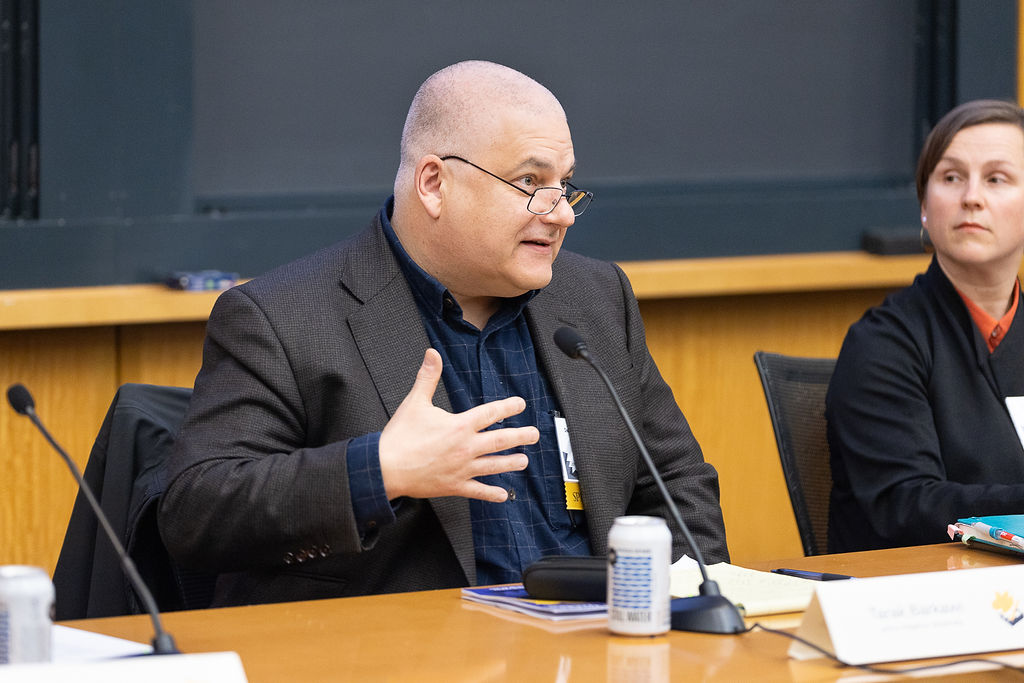
Barkawi warned that decolonization runs deeper than simply gaining national independence. He pointed out that colonial powers, not wanting to deal with “unruly colonies,” may opt to hand control over to key parties, who can act as substitutes in controlling the nations. This approach by the colonizers creates the illusion of sovereignty, while still discreetly sustaining old hierarchies.
Maria Sonevytsky, from Bard College, built on Barkawi’s claim that the language of decolonization can be misused, or misinterpreted. After all, Sonevystky pointed out that pro-Putin forces can hijack the term “decolonization” to justify war, as a rejection of American hegemonies.
Sonevytsky also resonated with Barkawi’s desire to reject old hierarchies. She suggested that Ukraine should move beyond the old binaries of colonized versus colonizer. Rather, she suggested that Ukraine use the experience of colonization to produce meaning and paint a new portrait of the future. She also said that true emancipation meant not fetishizing Europe, or becoming wholly dependent on Europe.
Kimberly St. Julian-Varnon of University of Pennsylvania continued to delve into the subject of how to decolonize without emulating the tactics of the colonizers. She discussed how Ukraine could reclaim its sense of self, by not reapplying imperialistic methods. “To decolonize Ukraine, is also to decolonize Russia,” St. Julian-Varnon stated. She also raised the question: What is Russia, if not an empire? If the Russian power structure were decolonized—if old hierarchies of domination were removed—what would remain of this culture?

Catherine Wanner from Penn State University dwelt on the dispossessing quality of colonialism: how it strips away one’s ability to articulate who one is, and what one is connected to. She expressed the view that Ukrainians had been forced to emulate their colonizers. Through this, people in places like America came to view Ukrainians as “almost Russians, but not quite.” To Wanner, colonization was not limited to losing land, wealth, or status. It is also a state in which “dispossession of identity is normalized.”
The general view of the conference attendees was that true decolonization for Ukraine was not just a matter of national independence, or a repudiation of all things Russian. Instead, it is a more radical notion: to create an independent sense of self, altogether. A view of identity, which is neither based around oppression, nor domination.