

The Temerty Contemporary Ukraine Program in Its Seventh Year
Translation of V. Dibrova’s article in Ukrainian.
In 2019, thanks to the financial support of the Ukrainian‑Canadian businessman and philanthropist James Temerty, the Temerty Contemporary Ukraine Program (“TCUP”) was established at HURI. Since then, this program has become one of the most important initiatives of the institute. Its director is Dr. Emily Channell‑Justice. The very list of annual conferences she has held testifies to the diversity and depth of the topics that Dr. Channell‑Justice has managed to cover over these years.
- 2021 – “Why Is Ukraine a Democracy.”
- 2022 – “Beyond Borderland: Thirty Years of Ukrainian Sovereignty.”
- 2023 – “Rebuilding Ukraine. Rebuilding the World.”
- 2024 – “Decolonizing Ukraine in Theory and Practice.”
- 2025 – “Landscapes of War, Landscapes of Victory: Ukraine’s Changing Environment.”
Each of these conferences became a platform for discussion and analysis of various aspects of the social, cultural, and political life of contemporary Ukraine. It is therefore not surprising that from the very beginning these conferences attracted the attention of leading scholars, public figures, and politicians from all over the world.
Preparations are now in full swing for another international conference under the aegis of HURI. We asked the director of the program to talk about this year’s conference, and fortunately, the conversation went beyond a mere list of topics, ideas, and names of organizers and participants.
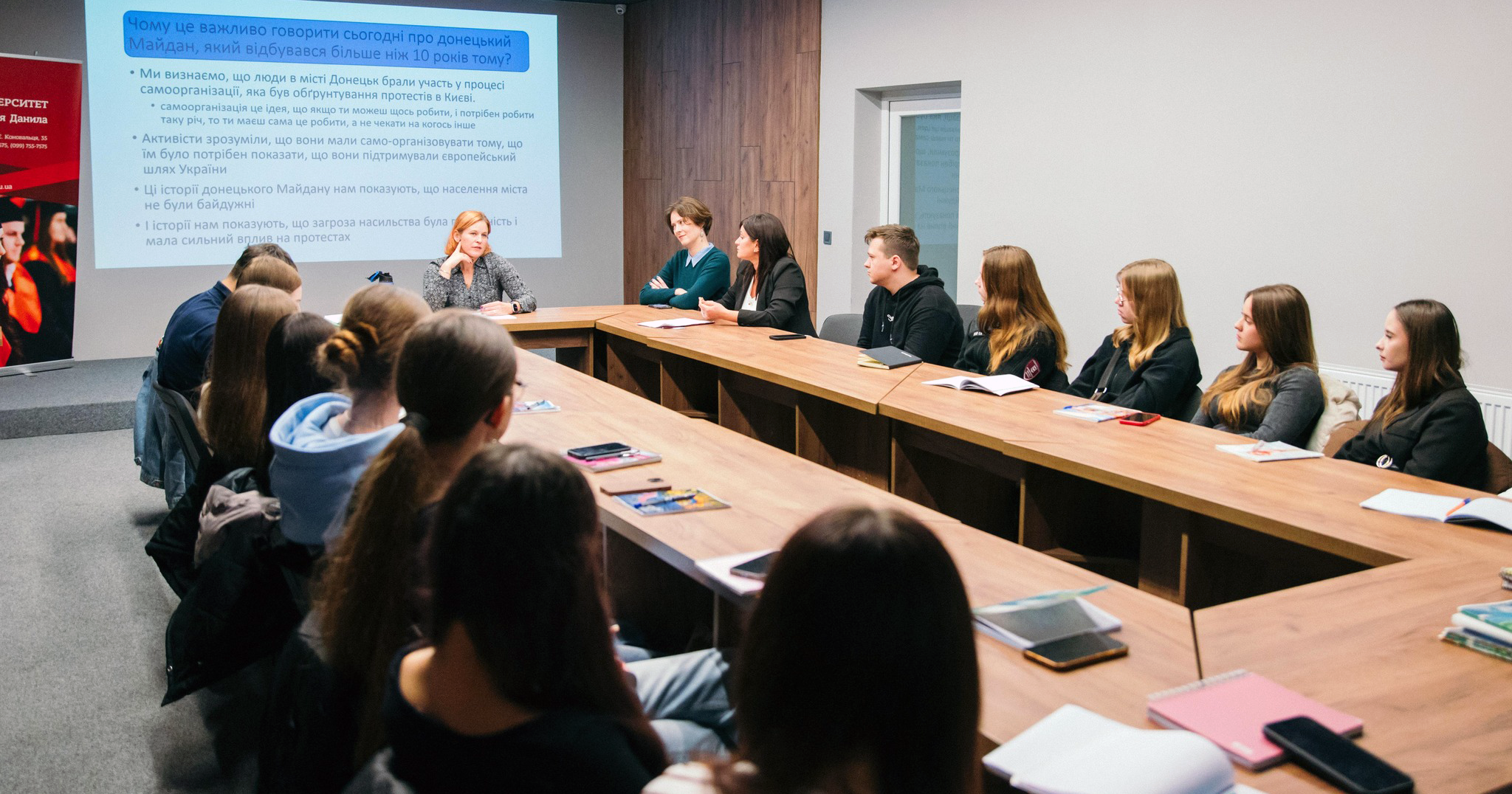
DR. EMILY CHANNELL‑JUSTICE:
THE TEMERTY CONTEMPORARY UKRAINE PROGRAM: THE EVOLUTION OF AN IDEA
We are now actively working on organizing the sixth conference within the TCUP program. It will be devoted to the theme of solidarity. Like all its predecessors, this conference will bring together leading experts from various academic disciplines, political figures, and civic activists who will discuss the most pressing issues of today. In the past our keynote speakers have included Jojo Mehta (2025), Dora Chomiak (2024), Oleksandra Matviichuk (2023), Ambassador Marie Yovanovitch (2022), and Francis Fukuyama (2021). Their presentations gave rise to extremely fruitful discussions. In addition, many of our panelists continue to develop the topics raised at these conferences and go on to publish articles and monographs.
It should also be said that TCUP’s activities are not limited to organizing conferences. Just this past year alone, we invited many scholars and civic activists to deliver lectures and other presentations at Harvard. Invited speakers included Maria Sonevytsky (Bard College), Sasha Dovzhyk (INDEX, Institute of Documentation and Exchange, Lviv), Olesya Khromeychuk (Ukrainian Institute, London), and Maryna Sapritsky‑Nahum (London School of Economics). In addition, jointly with the Davis Center’s Georgia Program, we established an annual international meeting of experts and civic leaders to discuss specific topics. The theme for the first gathering of this group focused on the independent media in Georgia and Ukraine. The speakers were David Herszenhorn, David Kirichenko, and Ia Meurmishvili. Our program also takes an active role in planning HURI’s weekly academic seminars and special events. Among these speakers were Lieutenant Colonel Alexander Vindman; Ambassador Marie Yovanovitch; Prof. Timothy Snyder; Prof. Catherine Wanner; Prof. Olga Onuch; Yevhen Hlibovytsky; Prof. Paul D’Anieri; and others.
The TCUP program strives to highlight not just what is most important and interesting to Ukrainian scholarship and Ukrainian studies globally. We also reflect on the opinions of leading political experts from whichever angle they perceive current situations. After Russia’s full‑scale invasion, many people with expertise on Ukraine called on us to be more sensitive and attuned to what is happening in Ukraine. With that in mind, we created a platform that accounts for and disseminates knowledge about the current situation in Ukraine.
As director of TCUP, I have had the opportunity to significantly broaden and deepen my understanding of the country. Both engaging in the TCUP Book Club and participating in the Institute’s numerous events have been a great help to me. Among the direct consequences of the full‑scale war, one can also note that many Ukrainian scholars began to seek financial support from foreign institutions because with the current conditions, this is the only way for them to expand their audience and be heard. So, paradoxically the war has created new mechanisms for supporting Ukrainian academics.
In my first three years at HURI, my goal was to do everything possible to ensure that contemporary Ukraine received the attention it deserves. And starting in 2022, my goal was to transform TCUP into the main knowledge base about modern Ukraine for those who are just starting to take an interest in this country. I want this program to become a primary and indispensable resource for everyone interested in Ukrainian topics. Accordingly, I began to place emphasis not only on sociological research, but also on such fields as, for example, public health, medical anthropology, or contemporary art history. I would like everyone who becomes interested in our topics to understand that there is currently no more important and painful subject than the Russian‑Ukrainian war. But despite all this, the life of contemporary Ukraine is not limited to pain and suffering. Let us not forget this.
PERSONAL SCHOLARLY INTERESTS: “MINE” AND “OURS”
When I took up this position, it seemed to me that I would be able to spend several months a year in Ukraine, collecting materials for my ethnographic research. (At that time that I was intensively working on research about internally displaced people, or IDPs.) However, COVID, and then the full‑scale Russian invasion, shattered all my plans. So, I had to, in the first place, change my approach to my duties and, in the second, reduce the time I could devote to research. After 2022, interest in Ukraine around the world increased sharply, and therefore it was necessary to pay more attention to the public platforms that TCUP and HURI already had.
It is commonly believed that anthropology is practiced by solitary scholars; we immerse ourselves in fieldwork, study the collected materials, and then analyze them in accordance with existing academic prescriptions and postulates. However, fortunately, in reality, I had to discard all these stereotypes and engage in active cooperation with like‑minded colleagues. The basis of the materials I am currently working with is almost 80 interviews conducted by the anthropology PhD student Anna Trofimova in 2014, 2015, and 2016. This scholar is no longer able to process the data she collected, but she does not want this testimony to disappear without a trace; so, she handed it over to me for further work. I am infinitely grateful to her for this. Thus, as we see, joint efforts lie at the core of this research project.
In March 2025, I received funding from the Mellon Urban Initiative at Harvard University and invited a group of scholars to HURI who undertook to study and discuss in detail the above‑mentioned interviews and related materials. Among them were anthropologists, sociologists, historians, and political scientists. In addition, two scholars who worked on transcribing the collected audio materials held a seminar in which they shared their experience working with the interviews. I consider this collaborative work and the discussions that surrounded it to be one of the most productive and valuable events of my academic career. Later, I used this format several more times. In other words, only when I stopped viewing certain materials as “my property” was I able to reach a new level. This allowed me to ask completely different questions that went beyond “pure” anthropology. (Here, of course, I do not mean that the methods used in anthropology are flawed. But in the new context I had to refrain from limiting myself to them.) During our discussions we touched on countless issues, from ethical questions and mental well-being to the implicit meanings of the terms that appeared in specific interviews. I admit that if it had not been for COVID and the war, which forced me to change my approach, I would never have reached such a level of understanding of certain problems.
Although the writing of a book manuscript based on this project has not yet been completed, one could say that I am now “swimming in material,” and I increasingly feel the support of colleagues who helped me change my perspective. Now it is not just “my” project simply because my name stands under it. I feel increasingly confident because so many wise and generous like‑minded colleagues have joined it.
UKRAINE: LAND, COUNTRY, PEOPLE

I believe I have been extraordinarily lucky. I consider the time I spent in Ukraine on the eve of and during the full-scale war to be among the best periods of my life. This is all thanks to my work with TCUP and the understanding and generosity of HURI. During my visits to Lviv and Ivano‑Frankivsk, I was struck by the number of brilliant initiatives created after the start of Russia’s full‑scale invasion. Some of them had existed before but were radically reworked. In October 2025, during my last visit, I spent a month at the Lviv Institute of Documentation and Exchange (INDEX), whose mission is to support writers and scholars. That Institute also has a separate program for veterans who have returned from the combat zone. INDEX funds both Ukrainian and foreign writers and scholars, gives them the opportunity to spend some time in Lviv, attend various cultural events, and provides them with housing and a place for creative work. INDEX has also created a strong network of specialists in various fields of science and art who in every possible way help those of us who spend limited time in Ukraine and would like to make the most of this opportunity. In addition, the veterans’ program takes into account all the changes that Ukrainian society is currently undergoing and does everything possible to help service members adapt to the new conditions of civilian life. And finally, INDEX tirelessly works to honor the memory of our colleague Victoria Amelina and other cultural figures whose lives were so mercilessly cut short by this war. And this is only one example of the new initiatives that have arisen in Ukraine since the beginning of the war. I have no doubt that they will survive these hard times. For me personally, it is a great honor to be part of the programs and network of INDEX.
I am inspired by the fact that Ukrainian studies are becoming increasingly prominent in North America and Europe. It is a pity this did not happen earlier, but we should focus on the fact that thanks to the persistent efforts of my colleagues from various institutions around the world, this academic field grows and strengthens every year. My teaching work at the Harvard Summer School is also a source of optimism. HURI continues to be the flagship of Ukrainian studies worldwide, and TCUP has become the center that attracts scholars, cultural figures, and activists who care about Ukraine’s future. In my opinion, we should strive for as many universities as possible to establish departments and centers devoted to Ukrainian studies. For me, TCUP is the hub where the paths and interests of students, faculty, researchers, individual institutions, and all those who work in the field of Ukrainian studies converge, but who do not have as powerful a structure as the Ukrainian Research Institute at Harvard.
THE JANUARY CONFERENCE UNDER THE AEGIS OF TCUP

The conference we plan to hold at the beginning of 2026 will be devoted to the theme “Solidarity Within and Beyond Ukraine.” I would like the invited speakers to frankly share their thoughts on the very meaning of the concept of “solidarity” in relation to war‑torn Ukraine, especially now, when the United States is so openly abandoning its leadership, and European allies lack determination and unity. Their initial monolithic support is visibly cracking before our eyes. At the same time, I would like to pose this question in such a way as to return to the purely political meaning of this term, that is, how “solidarity” is understood by Ukrainian activists. (In fact, this is what I began my research with.) This summer, near the front line in Zaporizhzhia, the artist and anarchist Davyd Chychkan was killed. He was the soul of the political community with which I once worked. He gave his life for the truest meaning of the word “solidarity,” for a future in which every Ukrainian would have the right to their own political views. At least in part I chose this theme for this next conference in honor of Davyd Chychkan, to challenge those who consider Ukraine something distant and insignificant, and something that does not align with their political priorities. I want to convey to them one simple idea: right now, every day, at this very moment in Ukraine, people with different political views and life experiences are fighting and dying so as not to let imperialism and authoritarianism prevail.
At the beginning of the conference, which will open on January 29, 2026, there will be a screening, initiated by Harvard students, of the documentary film “2000 Meters to Avdiivka.” The conference sessions are scheduled for January 30 and 31, 2026. Participants will discuss the following topics:
- Global solidarity with Ukraine;
- Political activism and the engagement of civil society organizations;
- Solidarity under occupation;
- Activism and advocacy.
On January 30, the keynote address will be given by former soldier, human rights defender, and journalist Maksym Butkevych.
Emily Channell‑Justice received her bachelor’s degree from American University (Washington, DC, USA), her master’s degree from Hunter College (City University of New York), and her PhD in anthropology from the City University of New York, Graduate Center. The topic of her doctoral dissertation is “Left of Maidan: Self‑Organization and the Ukrainian State at the Edge of Europe.” In it, she argues in particular that during the Revolution of Dignity it was precisely those groups that traditionally find themselves at the margins of political and social life that were able to formulate and actively promote arguments that soon became the most widely accepted.
After completing her PhD, E. Channell‑Justice was a postdoctoral fellow assistant professor in international studies at the Havighurst Center at Miami University (Ohio, USA).
Since 2012, she has been conducting research on contemporary Ukrainian politics, economics, and societal development. She is especially interested in such topics as the phenomenon of self‑organization and political activism, various social movements, gender issues, and the construction of relations between the state and society.
Emily Channell‑Justice is the author of the book Without the State: Self‑Organization and Political Activism in Ukraine (University of Toronto, 2022) and the edited collection Decolonizing Queer Experience: LGBT+ Narratives from Eastern Europe and Eurasia (Lexington Books, 2020). She has also published her scholarly articles in journals such as History and Anthropology and Signs: Journal of Women in Culture and Society.