

The Institutional Foundations of Ukrainian Democracy: Power Sharing, Regionalism, and Authoritarianism

Date and Time
Location
A book talk by author Nataliya Kibita, a scholar of 20th-century Ukrainian history and institutional change and an academic visitor at the University of Oxford.
Moderated by Emily Channell-Justice, Director of the Temerty Contemporary Ukraine Program at HURI and Nataliya Shpylova-Saeed, Preceptor in Ukrainian and head of the Ukrainian Language Program in the Department of Slavic Languages and Literatures at Harvard
This event is part of a new online series featuring publications that engage with decolonial frameworks in Ukrainian studies. The series is organized by the Temerty Contemporary Ukraine Program at HURI and hosted by Emily Channell-Justice and Nataliya Shpylova-Saeed.
About the Book
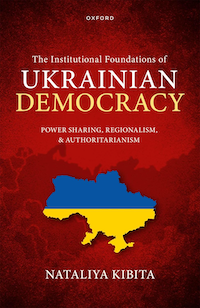
Ukraine and Russia are today at opposite ends of the political spectrum. Despite 300 years of full submersion into Russian authoritarian system, Ukraine has rejected authoritarianism. To explain why and how Ukraine’s road diverged from Russia’s, this monograph investigates the origins of regionalism in Ukraine, which is at the foundation of the Ukrainian institutional system. ‘Weak centre, strong regions’ was characteristic of both Ukraine and Russia in the early post-Soviet years. However, what was a detour for Russia was a long-standing framework in Ukraine. The story follows the relationship between Moscow, Kyiv, and the Ukrainian regions in the period from spring 1917 to summer 1994. Based on new archival material and guided by the theory of institutions, the book examines how interlinked political and economic incentives and constraints determined the opportunities and institutional interests of the Ukrainian leadership and the Ukrainian regions, and how the institutional framework affected the dynamic of the relationship between the central leadership in Moscow, the Ukrainian leadership, and the regions. It shows that, once established, the configuration of ‘weak centre, strong regions’ did not change, even when the Soviet centralized party-state system collapsed. The failure of the Ukrainian leadership to reconfigure the interplay of incentives and constraints that dictated the behavior of the Ukrainian regions determined not only the insignificance of the disintegration of the Soviet system, but also the institutional weakness of the new Ukrainian executive branch and the failure by President Kravchuk to establish some form of authoritarian rule. [source]
About the Speaker

Nataliya Kibita received her BA from the Ostroh Academy in Ukraine, and PhD from the University of Geneva, Switzerland, in 2008. Since then, she has taught at the Universities of Glasgow and Edinburgh and the LSE. In June 2019, after a four-month fellowship at the Ukrainian Research Institute at Harvard University, she re-joined the Department of History at the University of Edinburgh as a Visiting Research Fellow. She is currently an Academic Visitor in Russian and East European Studies at the Oxford School of Global and Area Studies, University of Oxford.
Kibita is the author of Soviet Economic Management under Khrushchev: The Sovnarkhoz Reform (Routledge, 2013) and The Institutional Foundations of Ukrainian Democracy: Power Sharing, Regionalism, and Authoritarianism (Oxford University Press, 2024).
This event is organized by the Temerty Contemporary Ukraine Program (TCUP) at the Harvard Ukrainian Research Institute as part of the Decolonizing Ukrainian Studies online event series.
Persons with disabilities who wish to request accommodations or who have questions about access should contact HURI Programs Manager, Megan K. Duncan Smith, at least two weeks in advance of the session.
Watch videos of past HURI events on our YouTube Channel and subscribe to our email list to receive announcements about events and other activities.