

Gallery with a Forest View: On Informal Art Spaces in Ukraine, 1960s-2025

Date and Time
Location
A lecture by Lizaveta German, curator, art historian, and co-founder of The Naked Room, Kyiv
Moderated by Emily Channell-Justice, Director of the Temerty Contemporary Ukraine Program at HURI
Image: Installation view of works by Tamara Turliun, Everyone is Afraid of the Baker, But I Am Grateful, Irpin, Ukraine, 2022. Photo courtesy of Kateryna Iakovlenko.
About the Lecture
The history of Ukrainian art in the 20th century, much like that of any other country, can be told and interpreted in numerous ways. In her talk, Lizaveta German will not only focus on artists’ biographies and artworks but also on how and where they managed to present their creative practices to the public — often a limited audience — under various, yet similarly unfriendly political circumstances of both the past and the present. Dr. German will delve into selected projects and initiatives organized around four key episodes: the underground scene of the 1960s, the early years of state independence in the 1990s, the off-spaces and self-organization movements of the post-revolutionary 2000s–2010s, and the wartime art projects that have emerged since 2022.
What do these periods share conceptually? Dr. German argues that these four episodes each represent an intensive search for strategies of alternative artistic representation to oppose the established art infrastructures and policies (or their absence) of their respective times. In simpler terms, they reflect a striving to break free from limitations, conformism, and intellectual entropy under different political circumstances that are either hostile or completely indifferent towards artists. This lecture examines how independent artistic and curatorial practices in Ukraine have proven to be the most effective strategies for resisting the destructive counterforces of the past 70 years—namely, the Soviet regime, the turbulence of the transitional period, the aftermath of the Orange Revolution and the Revolution of Dignity, and the full-scale invasion by Russia.
About the Speaker
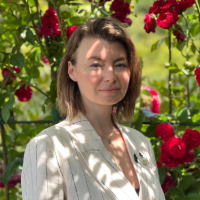
Lizaveta German is a curator, art historian, and co-founder of The Naked Room, Kyiv. She lives and works in Kyiv. Dr. German received her PhD in Art History from the National Academy of Fine Arts and Architecture in Kyiv. She was a curator-in-residence at the 2016 Liverpool Biennial of Contemporary Art, supported by the British Council in Ukraine. Together with Olha Balashova, German is the co-author of The Art of Ukrainian Sixties (2015, republished in English in 2021) and co-editor, with Balashova, of Decommunised: Ukrainian Soviet Mosaics (2017). She is currently working on a book about the artist Hryhorii Havrylenko and a book on curatorial practices in Ukraine since 2022, which is forthcoming with IST Publishing in 2026. She teaches at Taras Shevchenko National University of Kyiv and Lviv National Art Academy.
Since 2014, German has worked with Maria Lanko as a curatorial collective. The duo has organized more than 30 exhibitions in Ukraine, including at the National Art Museum of Ukraine, Mystetskyi Arsenal, Goethe-Institut, British Council, Ministry of Foreign Affairs, and Ukrainian Institute. In 2015, they presented a show at the Badischer Kunstverein Karlsruhe, as part of the Kyiv Biennial – School of Kyiv project. In 2017, they co-curated (with Kateryna Filyuk) the Festival of Young Ukrainian Art at Mystetskyi Arsenal, the first all-Ukrainian biennial of contemporary art. Since 2020, German and Balashova have been teaching a course, "System of Contemporary Art," at Skvot.IO online school. Their project with the artist Pavlo Makov (co-curated by Borys Filonenko), Fountain of Exhaustion: Acqua Alta, was chosen to represent Ukraine at the prestigious Venice Biennale in 2022. In addition to the Ukrainian pavilion in Venice that year, German co-curated two supplemental projects: the Piazza Ucraina project and the Decolonising Art: Beyond the Obvious interdisciplinary program.
This event is organized by the Harvard Ukrainian Research Institute as part of the Seminar in Ukrainian Studies public event series and the Temerty Contemporary Ukraine Program.
Persons with disabilities who wish to request accommodations or who have questions about access should contact HURI Programs Manager, Megan K. Duncan Smith, at least two weeks in advance of the session.
Watch videos of past HURI events on our YouTube Channel and subscribe to our email list to receive announcements about events and other activities.