

Crimean Fig / Qırım İnciri: Contemporary Crimean Tatar Poetry and Fiction

Date and Time
Location
A book talk and discussion of Crimean Fig with Alim Aliev and Nataliya Shpylova-Saeed
Moderated by Emily Channell-Justice, Director of the Temerty Contemporary Ukraine Program at HURI
This event is part of a new online series featuring publications that engage with decolonial frameworks in Ukrainian studies. The series is organized by the Temerty Contemporary Ukraine Program at HURI and hosted by Emily Channell-Justice and Nataliya Shpylova-Saeed.
About the Book
Crimean Fig /Qırım İnciri: Contemporary Crimean Tatar Poetry and Fiction features stories and poems by contemporary Crimean Tatar writers. Shadowed by history, their work reflects the traumas endured by Crimean Tatars over the last three and a half centuries. They further chronicle the complex process of a people’s efforts at reintegration into an ancestral land from which they’d been exiled for over half a century. One hears, in both the stories and poems, a cultural and national pride, a love for a landscape of stunning natural beauty, and a longing for the stability of peace. Edited by Nataliya Shpylova-Saeed, Anastasia Levkova, and Askold Melnyczuk. Foreword by Alim Aliev. [source]
About the Speakers

Alim Aliev is a writer, journalist, human rights activist, researcher, and manager of educational and cultural projects. He is the Deputy Director of the Ukrainian Institute (Kyiv), a co-founder of Crimea SOS, and a member of PEN Ukraine. He previously worked as a program director of the state enterprise “Crimean House”, a member of the supervisory boards of the NGO “Centre of United Actions,” and the NGO “Educational Center for Human Rights” in Lviv. After Russia’s occupation of Crimea in 2014, Alim Aliev moved to Kyiv. In 2018, he founded the Ukrainian-Crimean Tatar literary contest and festival Crimean Fig (Qirim Inciri), which is dedicated to the promotion of Crimean Tatar literature and culture in Ukraine and beyond.
Aliev is a member and rapporteur of advocacy missions to the Council of Europe, the European Parliament, the OSCE, the UN Security Council, EU and US political institutions on the situation in Crimea, the initiator of the digital museum of deportation of Crimean Tatars “Tamırlar”. His public and professional activities are focused on the topics of the occupied Crimea, humanitarian policy, the current state of the Crimean Tatar people, freedom of speech and communication strategies. Aliev graduated from V.I. Vernadsky Taurida National University, majoring in “Political Science”. He is a co-author of the recently published book, Mustafa Dzhemilev: The Unbreakable, about the life of the Crimean Tatar leader, and wrote the Foreword for Crimean Fig /Qırım İnciri: Contemporary Crimean Tatar Poetry and Fiction.
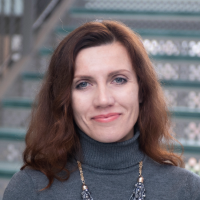
Nataliya Shpylova-Saeed is Preceptor in Ukrainian and head of the Ukrainian Language Program in the Department of Slavic Languages and Literatures at Harvard University. She is interested in memory studies, particularly in contested memory focusing on Ukraine and Russia. Contested memory offers insights into identity construction and negotiation, ways to explore options for conflict resolution, venues to establish complex networks of freedom and resilience, guilt and responsibility, censorship and self-censorship, oppression and coercion, protest and resistance. Shpylova-Saeed studies the formation, circulation, and repercussions of mnemonic contestations woven into the texture of cultural memory in Ukraine from the period of the Russian Empire through the Soviet Union into the present. Her work has been published in journals and newspapers, including The Ukrainian Weekly, Euromaidan Press, Times Higher Education, Small War Journal, PolitArena, and Forum for Ukrainian Studies.
Nataliya Shpylova-Saeed is the author of Russia’s Denial of Ukraine: Letters and Contested Memory (Lexington Books Press, 2024). Her current research project “Russia’s Memory of the Past: The War Against Ukraine and the Forgotten Future” focuses on the intricate mnemonic matrix utilized by the Kremlin since the early 2000s to shape the collective memory in Russia that comfortably accepts the denial of Ukraine’s sovereignty and justifies the eradication of Ukraine and Ukrainian identity as Russia’s self-defense measure. She is an H-Ukraine review editor and host on the New Books Network (Ukrainian, East European, and Literary Studies channels). Shpylova-Saeed co-edited Crimean Fig /Qırım İnciri: Contemporary Crimean Tatar Poetry and Fiction (Arrowsmith Press, 2025).
Before completing a Ph.D. in Slavic studies, Shpylova-Saeed received a Ph.D. in American literature. She studied the works by Richard Brautigan and the dynamics of American postmodernism, its subversive artistic expressions, political attitudes, and ideological underpinnings.
This event is organized by the Temerty Contemporary Ukraine Program (TCUP) at the Harvard Ukrainian Research Institute as part of the Decolonizing Ukrainian Studies online event series.
Persons with disabilities who wish to request accommodations or who have questions about access should contact HURI Programs Manager, Megan K. Duncan Smith, at least two weeks in advance of the session.
Watch videos of past HURI events on our YouTube Channel and subscribe to our email list to receive announcements about events and other activities.