

Continuity or Rupture? What Data Science Reveals about Russia’s Politics of Memory during the Russo-Ukrainian War

Date and Time
Location
A lecture by Bartłomiej Gajos, Senior Research Fellow at the Mieroszewski Centre, Poland
Moderated by Serhii Plokhii, Mykhailo S. Hrushevs'kyi Professor of Ukrainian History, Department of History at Harvard
About the Lecture
This paper argues that the Russo-Ukrainian War has produced a qualitative transformation in Russia’s politics of memory. While the use of World War II as a legitimizing myth has long been a feature of Russian state discourse, what is new is the immediate memorialization of the ongoing “Special Military Operation” as a sacred event on par with the “Great Patriotic War.” Drawing on data science methods — including large-scale text mining, sentiment mapping, and co-occurrence analysis — the study traces how the Kremlin’s historical narrative has evolved from retrospective commemoration to real-time myth-making. A key case in point is the 2025 volume On the 80th Anniversary of the Great Victory, published by the Security Council of the Russian Federation and nominally authored by its 33 members. Computational analysis of this 500-page text reveals that references to the “Special Military Operation” appear almost as frequently as those to World War II, signaling the deliberate fusion of both wars into a single ideological continuum. This merging of past and present marks a profound shift: history is no longer used to interpret the present, but the present is re-inscribed into the canon of national memory. The study thus exposes how Russia’s ruling elite now sacralizes its own war as living history.
About the Speaker
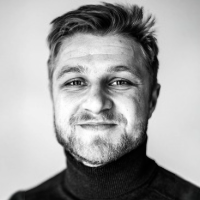
Bartłomiej Gajos is a historian of the Soviet Union and Russia whose work explores how power uses, distorts, and reinterprets history. He earned a PhD degree at the Institute of History of the Polish Academy of Sciences (IH PAN) for his thesis Politics of Memory of the Early Bolshevik Regime, 1917–1921. Currently, he combines archival research with data science methods to understand how narratives are shaped and contested. His research focuses on the politics of memory in contemporary Russia (1991–2025). He is the author of the recent article “Imperialism and Ethnonationalism in Russia’s Turbulent Years (1989–1994) – How Narratives of Unjust Borders Shaped Putin’s ‘Time Bomb’ Metaphor”, published in Nationalities Papers (2025).
A recipient of the Kościuszko Foundation Fellowship, he was a Visiting Fellow at Harvard University, hosted by the Davis Center for Russian and Eurasian Studies. His academic achievements have been recognized with the Polish Prime Minister’s Award, the START scholarship of the Foundation for Polish Science, and the Diamond Grant of the Ministry of Science and Higher Education. He currently works at the Mieroszewski Centre in Warsaw, where he studies Russian historical narratives and their impact on Central and Eastern Europe. Together with Dr. Ernest Wyciszkiewicz, he co-hosts Polihistor 2.0, a YouTube program about Russia and Central and Eastern Europe, which attracts around 250,000 views each month.
This event is organized by the Harvard Ukrainian Research Institute as part of the Seminar in Ukrainian Studies public event series.
Persons with disabilities who wish to request accommodations or who have questions about access should contact HURI Programs Manager, Megan K. Duncan Smith, at least two weeks in advance of the session.
Watch videos of past HURI events on our YouTube Channel and subscribe to our email list to receive announcements about events and other activities.