

Chornobyl Cinema: From Atomohrad Utopia to Contaminated Ruin

Date and Time
Location
A presentation by Stanislav Menzelevskyi, PhD candidate in Media Arts & Sciences at Indiana University and former head of the Research and Programming Department at the Ukrainian State Film Archive (Dovzhenko Centre)
Moderated by Serhiy Bilenky, HUSI Program Director at HURI
This event is organized by HURI as part of the Harvard Ukrainian Summer Institute (HUSI) Public Lecture Series.
About the Presentation
On 26 April 1986, the fourth reactor of the Chornobyl NPP, approximately 100 km north of Kyiv, exploded, marking one of the largest man-made disasters of the twentieth century and reshaping understandings of humanity’s impact on the environment. In the European context, Chornobyl was comparable in significance to the fall of the Berlin Wall, symbolizing the collapse of the Eastern Bloc and the promise of socialist internationalism. In Soviet Ukraine, Chornobyl evolved into a major sociopolitical crisis, contributing to the rise of anti-imperial and anti-Soviet movements and, as some scholars argue, paving the way for Ukrainian independence in 1991.
Focusing on films produced between 1972 and 1996, this presentation will examine how Chornobyl cinema navigated ideological constraints, perestroika-era transformations, and the post-Soviet transition. It analyzes how nuclear modernity was represented in Soviet cinema before 1986 and reworked in its aftermath.
About the Speaker
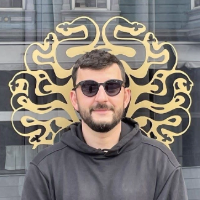
Stanislav Menzelevskyi is a PhD candidate in Media Arts & Sciences at Indiana University. He earned a BA and MA degrees in Arts in Cultural Studies from the National University of “Kyiv-Mohyla Academy.” Previously, Stas worked at the Ukrainian State Film Archive (Oleksandr Dovzhenko National Center) and served as the Head of the Research and Programming department. He has edited and co-edited several publications, such as Cinematic Revision of the Donbas (2017), Ivan Kavaleridze (2017), Chornobyl Invisible (2017), Ukrainian Film Critic Anthology of the 1920s (2018–23), and co-curated the exhibition VUFKU: Lost & Found (2019). Stanislav was a visiting scholar at Columbia University (Carnegie Fellowship, 2013) and the University of California, Berkeley (Fulbright Scholarship, 2019).