

Back to the USSR—and Farther: Russia’s War Against Ukraine, Mnemonic Abuse, And Memoricide

Date and Time
Location
A lecture by Nataliya Shpylova-Saeed, Preceptor in Slavic Languages and Literatures at Harvard University
Moderated by Serhiy Bilenky, HUSI Program Director at HURI
IN-PERSON and ONLINE via Zoom Webinar (live). Please register to attend in-person using the "REGISTER HERE" button above. To join online via Zoom, please register here.
This event is organized by HURI as part of the Harvard Ukrainian Summer Institute (HUSI) Public Lecture Series.
About the Lecture
What does New Year smell like? A Soviet crystal flacon would contain at least two defining notes: tangerines and Olivier salad. As Russia embraced increasingly aggressive memory strategies before and after launching its war against Ukraine, food memories proved remarkably enduring and emotionally resonant. The memory of the USSR—and later the Russian Empire—became an integral component of Russia’s broader mnemonic project aimed at reviving an idealized past in hopes of “returning” formerly subordinated nations to Moscow’s sphere of control after they embraced sovereignty and independence following the dissolution of the Soviet Union. When consuming traditional New Year dishes closely associated in Russian public perception with the Soviet Union, people across Russia were also consuming their portion of curated and constructed memory of the “good old days.”
The Russian entertainment industry became instrumental in mobilizing society around ambitions that were fundamentally imperial and expansionist in nature. Following Russia’s occupation of Crimea and military involvement in the Donbas in 2014, a series of concerts was launched to “celebrate” what international law defines as a violation of sovereign borders. However, as this talk demonstrates, the groundwork for normalizing military aggression within Russian society had been laid years earlier. One revealing example is the annual New Year’s television programming broadcast on the state-controlled Channel One. These programs illustrate the gradual integration of nostalgia for the USSR, historical grievances, revanchist ambitions, and chauvinistic attitudes into public consciousness and cultural memory, alongside the persistent undermining of Ukraine’s legitimacy as a sovereign state since Vladimir Putin’s rise to power at the turn of the twenty-first century.
The talk emphasizes the concepts of mnemonic abuse and memoricide as central strategies in Russia’s genocidal war against Ukraine.
About the Speaker
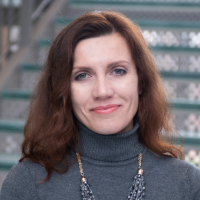
Dr. Nataliya Shpylova-Saeed teaches Ukrainian at Harvard University in the Department of Slavic Languages and Literatures. She is a memory studies researcher and literary critic. She writes on cultural memory, focusing on Ukraine and Russia. Her book, Russia’s Denial of Ukraine: Letters and Contested Memory, was published in 2024 (Lexington Books Press), and she is a co-editor of Crimean Fig/Qirim Inciri: Contemporary Crimean Tatar Poetry and Fiction (Arrowsmith, 2025). Her current research project is Memory Under Fire: Russia’s War Against Ukraine and the Forgotten Future.