# In Memoriam: David Frick (1955-2022)
March 23, 2023
- [ News ](/news-categories/news)
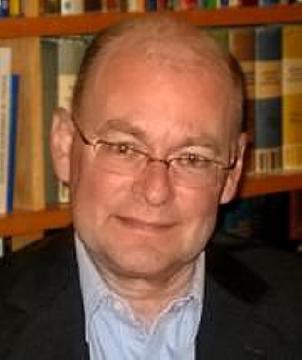
It was with shock and sadness that HURI learned of the loss of an esteemed colleague on December 10, 2022. David Alan Frick, Distinguished Professor Emeritus of Slavic Languages and Literatures at University of California, Berkeley, had an outsized impact on the field of Ukrainian studies and particularly Ukrainian literature. Here, George G. Grabowicz, Dmytro Čyževs’kyi Research Professor of Ukrainian Literature, and Michelle Viise, HURI Monographs Editor, reflect on David’s work as a multifaceted and inspiring Slavist as well as his rich presence as a mentor, colleague, teacher, and friend. \*\*\*
Der Tod ist groß.
Wir sind die Seinen
lachenden Munds.
Wenn wir uns mitten im Leben meinen,
wagt er zu weinen
mitten in uns.
R. M. Rilke, Schlußstück
Our first response at hearing of David Frick’s death was shock and an acute sense of loss—he was still so young, many of us felt, and we all were expecting so much more from him. It was also, of course, the shock of facing our own mortality. In the natural order of things, we took his presence among us as normal and usual and somehow permanent, and now he was gone. Whether we saw him as an esteemed younger colleague or an older, esteemed mentor, his departure—so it began to sink in—was real. We will no longer be able to learn from him through a living discourse, to simply call him or go to him for advice or ask for a contribution, but will have to learn to plumb his legacy with the tools of our trade—which he did so much to develop and hone—and apply his insights. He was now becoming part of our canon. This had been happening for some time, of course, but now we were seeing it more starkly.
\*

From the very beginning of his scholarly career, from his graduate work at Yale with Riccardo Picchio and Harvey Goldblatt, and drawing on their example and achievements, David, with characteristic discernment, chose to focus on those aspects of Slavic studies that were not often studied in today’s mainstream—but also promised essential contribution to the field. He focused on the early modern period and the literatures of the Polish-Lithuanian Commonwealth, particularly the Polish and the Ruthenian (Ukrainian and Belarusian) works, and perhaps most importantly the ways in which the respective literary processes absorbed, transmitted, and mediated complex cultural influences between the European West and the Muscovite East. The fraught nature of those influences and confrontations would end up affecting East European cultural and political history for centuries to come—and their aftershocks are being felt on the battlefields of today’s Ukraine. In 1982 David joined the faculty of Slavic Languages and Literatures at the University of California, Berkeley, as an assistant professor. He took his place in the chair vacated by Nobel Prize winner Czesław Miłosz, a succession that his many Polish colleagues and friends never fail to mention as a sign of his worthiness. At Berkeley, David advised dozens of graduate students and undergraduates alike. As intimidating as his brilliance was, it was masked by an unassuming demeanor. David was always ready to give practical advice for approaching problems in study and research. By dint of his welcoming nature as well as his scholarship, he influenced a sizable “school” of younger scholars to pursue unexamined topics in Polish and Ukrainian early modern studies.
\*
David’s impact on Ukrainian literary studies and particularly on Ukrainian literary historiography has been fundamental. At Yale, he wrote his dissertation on Meletii Smotryts'kyi and submitted it for a PhD degree in 1983. The dissertation was reworked into a monograph, his *[Meletij Smotryc'kyj](https://www.hup.harvard.edu/catalog.php?isbn=9780916458553)*, which appeared in 1995.[1](/news/memoriam-david-frick#Note1) It was preceded in 1987 by volume 1 of the Texts Series of the Harvard Library of Early Ukrainian Literature (HLEUL) under the title *[Collected Works of Meletij Smotryc'kyj](https://www.hup.harvard.edu/catalog.php?isbn=9780916458201)*, presented in a facsimile edition and with a comprehensive introduction by David Frick.[2](/news/memoriam-david-frick#Note2) And it was followed in 2005 by his *[Rus' Restored: Selected Writings of Meletij Smotryc'kyj 1610-1630](https://www.hup.harvard.edu/catalog.php?isbn=9780916458645)*, which is volume 7 of the English Translations Series of the HLEUL. *Rus' Restored* includes fifteen major works of Smotryts'kyi’s, from his groundbreaking *Threnos* of 1610, which is arguably the first major work to initiate the century and a half period of religious polemics in seventeenth- and eighteenth-century Ukrainian literature, to his 1630 letter to Pope Urban VIII on how to reunite Rus' and implicitly provide for its sustenance and status in the Polish-Lithuanian Commonwealth. The annotated texts are given in an excellent, sensitive translation which, even though only a selection, is huge: just over 800 pages, again with a substantial introduction by Frick that makes Smotryts'kyi’s legacy readily accessible to the Western reader.
\*
[](https://www.hup.harvard.edu/catalog.php?isbn=9780916458553)
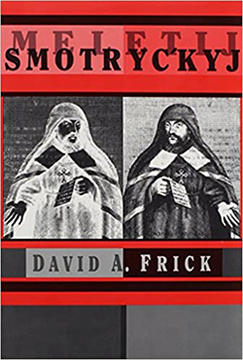
The centerpiece of David’s contribution to Ukrainian literary history is, of course, his monograph, *Meletij Smotryc'kyj* (1995). It is that relatively rare instance of a scholarly work focusing unerringly on a major, defining moment (here, centered on a person), which fittingly is both a lacuna and an aporia of a whole literary-historiographic tradition—and, crucially, a cross-cultural one, that is, a tradition not just Ukrainian, but also Polish and Russian—of interpreting and misreading Smotryts´kyi’s conversion from Orthodoxy to Catholicism (specifically, the Union) as only one of two possible choices: either of “betrayal” and “apostasy” (the Orthodox take), or of choosing God, reason, and righteousness (the Uniate and Roman Catholic take). The lacuna in question was precisely that a huge gamut of cultural and political issues relating to Ukraine in the Polish-Lithuanian Commonwealth during Smotryts'kyi’s lifetime and for decades and centuries after; much, if not all, of the scholarship that was devoted to this topic was supplanted by that reductive, and ultimately misleading, binary choice. If scholarship, like science (both, after all, are *nauka*), is made through paradigm shifts, then in the broad field of Ukrainian studies one is hard pressed to find a more striking instance. That Meletii Smotryts'kyi was a major early modern Ukrainian literary figure, entirely on the order of a Vyshens'kyi or a Skovoroda, may have been felt or intuited by other literary historians—the breadth of Smotryts'kyi’s output speaks for itself and mandates that assessment—but David’s study, with its massive apparatus and exemplary close reading of texts, makes his central role irrefutable and directly poses a number of other, key questions that still require answers. In a very real sense, the issue is larger than Smotryts'kyi, his life, his conversion, and his multiple and convoluted strategies, and becomes emblematic of the tortuous path of Ukrainian nation formation—not only in the tumultuous seventeenth century, but well beyond—and clearly obligates us to further analysis. [](https://www.hup.harvard.edu/catalog.php?isbn=9780916458645)

By his own reckoning, David’s focus on Meletii Smotryts'kyi and the paradigm shift that he was introducing into Ukrainian studies lasted for about two decades; as he says in the Acknowledgements at the end of his Introduction to *Rus' Restored:* “I have been working on this project, on and off, for about twenty years, so the ineffability *topos* is not merely a *topos* in this case.” (A modesty *topos* may also be at play here: like strong poets, strong critics know their own worth.) Between receiving his degree and publishing Meletij Smotryc'kyj, David published in *Harvard Ukrainian Studies* seven substantial articles that address fundamental issues in Ukrainian literature, history, and culture, as well as aspects of their interaction with the Polish and the Russian contexts; all of them cast new light on the complexities of Ukrainian nation formation. Four of them deal largely with Meletii Smotryts'kyi and anticipate the coming monograph—although they also can and do stand alone and are not just fragments or previews of what is to come.[3](/news/memoriam-david-frick#Note3) But three of them go directly and by all indications programmatically beyond *Meletij Smotryc'kyj* and address the broader historical issues of Ukrainian identity-formation vis-à-vis both the Commonwealth and Muscovy. Most importantly, they also examine the underlying epistemological reefs that the historian, student of culture, and, as David wryly adds at one point, scholar-detective must negotiate in his research.[4](/news/memoriam-david-frick#Note4) Coming as they do on the eve of the publication of *Meletij Smotryc'kyj*, these works may well have been overshadowed by the brilliance of the monograph. But their importance is real, and they deserve renewed attention. Particularly striking here is the last of these, the article “[Foolish Rus'](https://www.jstor.org/stable/41036902),” which directly confronts the centuries-long contempt that the Polish elites had for their fellow countrymen “of the Rus' persuasion” (as another trope familiar in the US would have it) and which poisoned relations between the two polities for centuries and through multiple hypostases, but also sped the formation of Ukrainian nation-formation, and is now being healed, in real time and perhaps definitively, in the face of the common enemy from the east.[5](/news/memoriam-david-frick#Note5) \*
[](https://www.cornellpress.cornell.edu/book/9780801451287/kith-kin-and-neighbors/#bookTabs=1)
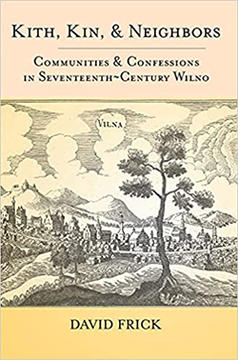
The cultural-anthropological approach that informs the “Foolish Rus'” article was developed further just a year later in “[Sailing to Byzantium: Greek Texts and the Establishment of Authority in Early Modern Muscovy](https://www.jstor.org/stable/41037000),” which David submitted for a Festschrift honoring Edward L. Keenan.[6](/news/memoriam-david-frick#Note6) Sometime in the late 1990s, Frick began a painstaking reconstruction of neighborhoods in mid-seventeenth-century Vilnius, combing through court records for descriptions of the interactions between the residents of the city’s multiple confessions and religions. This research was to produce a number of talks and publications, for example, David’s 2005 article “Jews and Others in Seventeenth-Century Wilno: Life in the Neighborhood.”[7](/news/memoriam-david-frick#Note7) Just two years later he was a coeditor, along with Stefan Rohdewald and Stefan Wiederkehr, of *Litauen und Ruthenien/ Lithuania and Ruthenia*, a German-English collection of studies of this “transcultural communication zone” in the fifteenth to eighteenth centuries. In 2008, he published a monumental collection of archival documents and reconstructed maps describing Vilnius and its inhabitants, *Wilnianie. Żywoty siedemnastowieczne*. This publication was followed by his magisterial overview of the urban anthropology of the city, with a parsing of its particular culture and language, in the expansive *[Kith, Kin and Neighbors: Communities and Confessions in Seventeenth-Century Wilno](https://www.cornellpress.cornell.edu/book/9780801451287/kith-kin-and-neighbors/#bookTabs=1)*.[8](/news/memoriam-david-frick#Note8) It would seem enough that David left us with a detailed recreation of Vilnius, thoughtfully arranged and contextualized, for analysis by future generations of scholars. But, as adept as he was at interpreting texts from the early modern period, David was a nimble and sophisticated reader of modern literature. With his Mozartean genius for translation, he rendered into English two novels by twentieth-century Polish writer Jerzy Pilch and a collection of the Polish correspondence of Chopin. In saying goodbye to David, we approach his prodigious work with new-found awe of his ability to so fully render people and places in their complex and unruly humanity.
George G. Grabowicz
Michelle Viise
\_\_\_\_\_\_\_
[1.](/news/memoriam-david-frick#NotePlace1) David Frick, *Meletij Smotryc'kyj* (Cambridge, Mass.: HURI, 1995).[2.](/news/memoriam-david-frick#NotePlace2) *Collected Works of Meletij Smotryc'kyj*, Harvard Library of Early Ukrainian Literature, Texts, v. 1 (Cambridge, Mass.: HURI, 1987).[3.](/news/memoriam-david-frick#NotePlace3) See David Frick, “Meletij Smotryc'kyj and the Ruthenian Question in the Early Seventeenth Century,” *HUS* 8, no. 3/4 (December 1984): 351–75; “Meletij Smotryc'kyj and the Ruthenian Language Question,” *HUS* 9, no. 1/2 (June 1985): 25–52; “Meletij Smotryc'kyj's Threnos of 1610 and Its Rhetorical Models,” *HUS* 11, no. 3/4 (December 1987): 462–86; and “Fides Meletiana: Marcantonio de Dominis and Meletij Smotryc'kyj,” *HUS* 15, no. 3/4 (December 1991): 383–413.[4.](/news/memoriam-david-frick#NotePlace4) See David Frick, "The Circulation of Information about Ivan Vyhovs'kyj," *HUS* 17. no. 3/4 (December 1993): 251–78; “The Uses of Authority and the Authority of Use: Philological Praise and Blame in Early Modern Rus',” *HUS* 18, no. 1/2 (June 1994): 76–93; and "'Foolish Rus´': On Polish Civilization, Ruthenian Self-Hatred, and Kasijan Sakovyč," *HUS* 18, no. 3/4 (December 1994): 210–48. [5.](/news/memoriam-david-frick#NotePlace5) It is, of course, anticipated by a general Polish-Ukrainian intellectual rapprochement that begins with the onset of Ukrainian independence in 1991. See especially *Nie jesteśmy ukrainofilami. Polska myśl polityczna wobec Ukrainców i Ukrainy:. antologia tekstów*, (Wrocław, 2002). [6.](/news/memoriam-david-frick#NotePlace6) David Frick, “Sailing to Byzantium: Greek Texts and the Establishment of Authority in Early Modern Muscovy,” *HUS* 19 (1995): 138–57.[7.](/news/memoriam-david-frick#NotePlace7) David Frick, “Jews and Others in Seventeenth-Century Wilno: Life in the Neighborhood,” *Jewish Studies Quarterly* 12, no. 1 (2005): 8–42.[8.](/news/memoriam-david-frick#NotePlace8) David Frick, *Wilnianie. Żywoty siedemnastowieczne* (Warsaw: Studium Europy Wschodniej, 2008); idem, *Kith, Kin and Neighbors: Communities and Confessions in Seventeenth-Century Wilno* (Ithaca: Cornell University Press, 2013).
Share on:- [ Facebook ](#)
- [ Twitter ](#)
- [ Linkedin ](#)